How to measure the ROI of gamification? KPIs and Methods
Voici les deux règles fondamentales à garder en tête lors de la mise en place de votre prochain challenge commercial. Ce retour d'expérience se base sur une enquête réalisée auprès de responsables commerciaux, organisateurs et participants aux challenges.


Sommaire
The ROI gamification is the decisive metric to justify any engagement program. In 2026, measuring the return on investment of gamification became essential to justify budgets in a financial direction. Companies that structure this monitoring observe productivity gains of 20 to 60%, according to Yu-Kai Chou, an expert in behavioral gamification. Objow, French leader in gamification, helps 25,000+ users to manage their KING via automated dashboards connected to CRMs. That is why we guide you here through the concrete steps of measurement and justification.
Why measuring ROI (gamification) became essential in 2026
Sales managers and CFOs are now demanding complete transparency: “How much is our return on investment really?” This requirement reflects the structural evolution of budgets towards impact measurement. According to Gartner, 70% of Global 2000 companies will have a gamified application in 2026, which accelerates the need to accurately quantify the measured profitability to justify annual renewals.
The benefits are observed at three levels: engagement (active participation), business performance (commercial or HR KPIs), and retention (reduction in churn or lifespan). Indeed, a successful program improves engagement from the first weeks, generates quantifiable results in 2-3 months, and reinforces loyalty over 6-12 months. This time progression structures your expectations and your internal communication.
At Objow, the experience with 25,000+ users reveals a recurring pattern: customers who measure their Value produced by gamification as early as week 1 (rather than at 6 months) obtain 3 times more quantifiable results at mid-year. This early follow-up transforms the gamification of a “soft” initiative into a justifiable performance lever for the steering committee, which secures the budget for year 2.
What KPIs to follow to assess the return on investment (gamification)
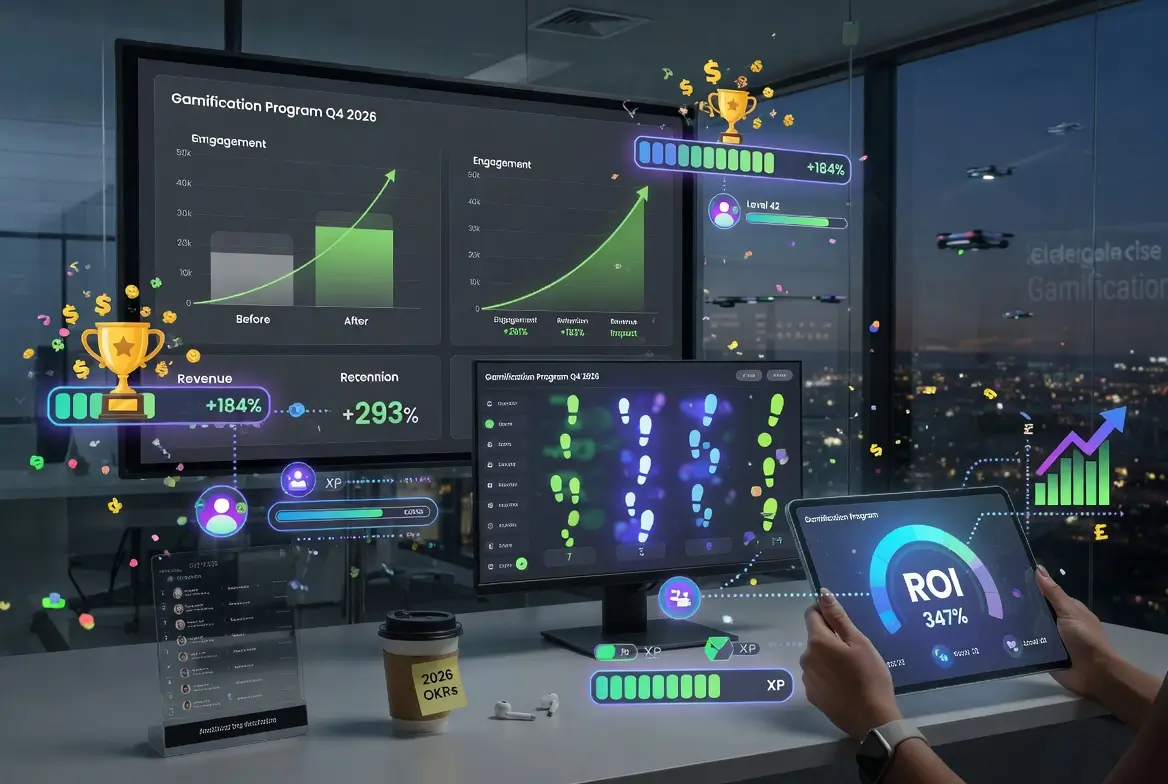
Measuring real impact requires differentiating between two categories of KPIs, as explained in our guide on The essential commercial KPIs. A distinction must be made between: adoption/commitment (upstream) and business performance (downstream). Upstream KPIs predict results by capturing participation. Downstream KPIs measure real results: additional sales, qualified leads, or reduced turnover. Concretely, a program can show a strong commitment (80% adoption) but a performance of the gamified device low if the commitment does not translate into real sales.
Engagement KPIs to measure adoption
The participation rate measures the percentage of employees who have accessed the program at least once. This is the key denominator that will validate sustainability. The frequency of use (sessions per participant per week) indicates recurring commitment: a frequency of 2-3 sessions/week indicates a program that is well integrated into the routines. The average session length (5-15 minutes depending on sector) captures the immersion. Finally, the rate of progress of levels or badges measures depth: a user who progresses goes through the stages of the program and consumes more content.
Business performance KPIs to justify the gamification ROI
Sales conversion directly generates revenue: additional turnover, number of contracts signed, or average order value. The generation of qualified leads completes this picture: number of new contacts, reduced cost per lead, lead-to-customer conversion rate. For HR, reduced churn measures the percentage of additional retention vs. control group and the savings in replacement costs. Finally, productivity summarizes: hours saved, volume of transactions per agent, or tasks completed per day. These four pillars structure your understanding of investment performance.
How to calculate the gamification ROI in 4 precise steps
The fundamental equation: ROI% = (Net Profits/Total Investment) × 100. Therefore, net profits = gains generated - variable costs - additional operational costs. The total investment = annual platform cost + technical integrations + initial training + salary for management and coordinators.
Real use case: a team of 50 salespeople. Year 1, investment = €50,000 (SaaS platform €25k + integration €15k + training €10k). Earnings generated = €200,000 in additional turnover measured vs control group. Variable costs (servers, support) = €15,000. Net profits = €200,000 - €15,000 = €185,000. **KING = (185,000/50,000) × 100 = 370% **. Payback period = 50,000/(185,000/12) ≈ 3.2 months. Ce benefits generated by the program of 370% validates immediate renewal.
Three essential tips structure this calculation: first, set up a control group (30% non-gamified, 70% gamified, same period) to isolate the real contribution. Second, monthly: commitment (months 1-2), initial results (months 2-3), full impacts (months 4-6). Third, analyze by chronological cohort (before/during/after launch) to validate that the improvement coincides with the program.
What is the true cost of a business gamification program
The actual cost often exceeds the initial estimate. The SaaS platform costs 5,000-50,000€/year depending on the complexity and size. Technical integration (connection to CRM, ERP, analytics) adds €10,000-30,000 in year 1. Initial training (launch, documentation, support) represents 5,000-15,000 euros. Full-time management and coordination cost 30,000-80,000€/year in salary. Therefore, the real cost year 1 oscillates between €50,000 (simple SaaS SMEs) and €150,000 (medium-sized business, complex integrations).
Year 2, costs are falling: no integration, reduced training, platform scaling. That's why the results of the gamified program Year 2 often reaches 200-500% on the same profit base. This dynamic justifies the initial investment: you pay for the infrastructure year 1, then profitability accelerates year 2 and beyond.
What benchmarks and typical results to expect to measure gamification ROI
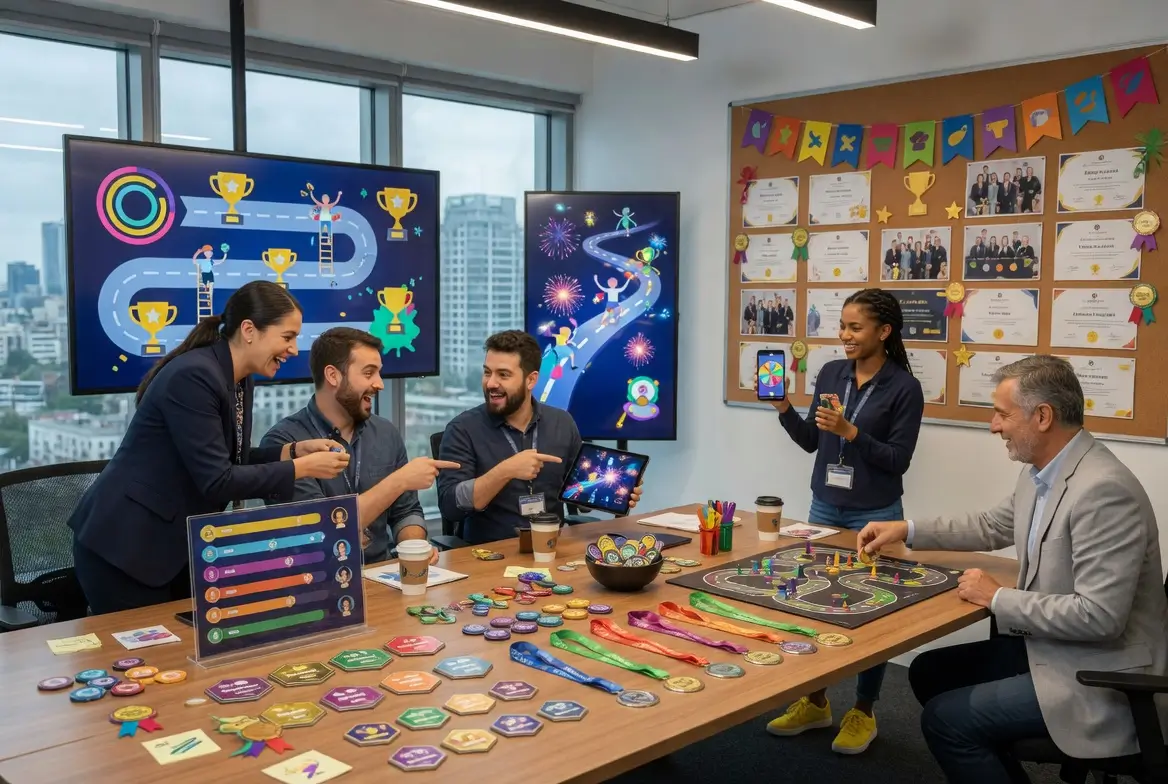
The results vary greatly by sector and by type of program. In sales (direct sales, sales force), returns typically reach 250-350% in year 1, with a payback period of 2-3 months. In HR (employee engagement), the ROI amounts to 120-200% over 4-6 months. For talent retention, the ROI reaches 80-150% over 6-12 months as the gains accumulate gradually. These figures reflect the maturity of the tools and methodologies: the new programs in 2026 are starting at 150% + thanks to the sophisticated solutions available. Table below.
The 5 mistakes that distort your ROI calculation (gamification)
First mistake: forgetting a control group. Without 30% of parallel non-gamified employees, you overcount results and ignore external factors (seasonality, economic cycles). Result: your numbers swell by 20-40% in false positivity. The second mistake is measuring too early. A pure engagement program shows results in 1-2 months. A retention program requires 3-6 months. Evaluate at 2 weeks = premature conclusion and unnecessary dropouts.
Third mistake: incomplete counting of operational costs. Forget time management, continuing education, technical integrations = measurable impact of the device artificially inflated. The real costs = platform + integration + salaries + internal customer support. Fourth mistake: changing your methodology from year to year. If you measure differently (October year 1 vs April year 2), the results are not comparable. Set your month 1 methodology and stick to it. Our article on The 3 KPIs to animate with gamification details the most reliable metrics.
Fifth mistake: giving up at the first low ROI. An ROI of 80-100% does not mean failure, it is a signal for optimization. Iterative adjustments (refined gamification, better segmented targets, simplified integrations) often increase the ROI from 80% (month 3) to 300% + (month 12). Patience and iteration pay off.
How Objow simplifies the management of ROI (gamification) and its KPIs
Objow provides four integrated tools to measure and optimize your profitability of gamification without manual friction. First, automated dashboards that synchronize engagement (participation rate, frequency, badges) and business performance (sales, leads, productivity) in real time. Second, pre-integrated connectors: Salesforce, HubSpot, Pipedrive, Pipedrive, Tableau, SAP, ensuring that your business data feeds directly into your gamification KPIs.
Third, cohorts by segment (junior vs. senior salespeople, by region, by product) that isolate profitability drivers. Fourth, adjustment alerts: if engagement falls by 20% month 2, Objow reports a risk of ROI and recommends a correction. These capabilities allowed our customers (CNP Assurances +1 contract per advisor per 2 days, PepsiCo +92% DN rate, T-Mobile +583% employee contributions) to justify budgets and expansions. This is why 83% of Objow customers renew their contract for year 2: the proof by the numbers. To understand the psychological drivers behind these results, consult our guide on work motivation and gamification.

Transform every euro invested into measurable and sustainable performance
Measure the program return on investment is only the beginning. To really succeed, document your methodology as early as 1 month, communicate your results monthly to stakeholders (CFO, COMEX), and prepare quick adjustments based on data. A program that shows its results monthly gets a budget renewal 92% of the time. Conversely, a program without clear follow-up disappears at the first budget review. Request an Objow demo to visualize how to manage your program live.
Frequently asked questions about gamification ROI
How do I define my gamification ROI goals from the start?
Start with the concrete business objective: increase in sales by 15%, reduction in churn by 10%, or productivity +20%. Translate it into measurable KPIs: “generate +50 leads/month” or “increase retention by 5 points”. Define the time horizon (3, 6, or 12 months). Capture a baseline before launch (sales previous months, churn rate previous years). The clearer and more measurable your goals, the easier it will be to link gamification to KING and to communicate the results. Finally, document your hypotheses: if you target +50 leads/month, what% increase in engagement do you expect to generate? Align these assumptions with industry benchmarks.
What is the minimum budget for a profitable gamification program?
A minimum SaaS program costs 5,000-15,000€/year (platform + basic management). The ROI generally becomes positive as soon as €20,000-30,000 invested thanks to rapid gains in commitment and productivity. For a real program with CRM integrations and dashboards, budget 40,000-80,000 euros year 1. At Objow, we recommend investing first on the tool and integration (months 1-3), then on progressive optimizations (months 4-12). Year 2, the cost decreases by 30-40% as you eliminate implementation costs and focus on maintenance and scaling. This dynamic justifies the initial budget: paying for infrastructure year 1, collecting 200-400% ROI years 2 and following.
How long does it take to see a positive and quantified gamification ROI?
Engagement increases visibly in the first 2-3 weeks post-launch: participation rates increase, badges unlocked, leaderboards active. Measurable business benefits (additional sales, leads generated) appear after 1-2 months for commercial programs. Gains in talent retention take 3-6 months because the impact on turnover accumulates gradually (fewer resignations, employee lifespan). A positive payback period (you get back your initial investment) is generally between 2 and 6 months. At Objow, customers notice a break-even around 3-4 months and an acceleration of ROI beyond that. This timing justifies 6 months of patience before evaluating the complete success of a program.
How to precisely isolate the contribution of gamification from other external factors?
Use three complementary techniques. First, a control group: 30% of identical employees (same region, same seniority, same type of customer) non-gamified in parallel, 70% gamified, over an identical period (e.g. January-June). Compare the performance month by month: if the gamified progressed +18% and the non-gamified +3%, the gamification explains 15 points. Second, chronological cohorts: measure before launch (baseline), then during (months 1-3), then after (months 4-6). If your sales only increase after launch and stagnate before launch, that's a strong signal. Third, isolate the peaks: if a weekly leaderboard boosts engagement every Friday, it's proof of the causal. Without a control group, accept a margin of error of 20-30% and document it in CFO.
What if my initial gamification ROI is low (less than 100%) in 3 months?
It is not a failure, it is a signal for adjustment and optimization. First check your control group: isolate the real contribution (not the raw results). Then, increase engagement: simplify onboarding, launch weekly competitions, improve visuals. Reduce fixed costs: do you really need the premium license? Or can you get it 20-30% cheaper? Extend your observation: an 80% month 3 ROI often becomes 180% month 6 and 350% year 1. We observed programs evolve from 80% (month 3) to 450% (month 12) through iterative adjustments. Therefore, a low initial ROI does not invalidate the program; it tells you where to optimize.
How to compare the gamification ROI between two programs or two different periods?
Three approaches standardize the comparison. First, compare the ROI% rather than the absolute revenue: a program generating €100k out of €50k invested (200% ROI) is less efficient than one generating €50k out of €25k invested (200% ROI too, but on an equivalent basis). Second, compare the ROI per active participant: if the program A = 300% out of 100 users = 3% /user, and B = 300% out of 50 users = 6% /user, B is more efficient density. Third, compare the payback period: independent of the absolute amount, it shows the speed of return. Finally, compare over the same periods of time because the ROI naturally improves over time: a 6-month program will always be better than a 3-month program. Normalize on this factor before conclusion.





.webp)