Commercial Incentive: Definition, Levers and Concrete Examples in 2026
Voici les deux règles fondamentales à garder en tête lors de la mise en place de votre prochain challenge commercial. Ce retour d'expérience se base sur une enquête réalisée auprès de responsables commerciaux, organisateurs et participants aux challenges.

Sommaire
the commercial incentive became, in 2026, a multi-stage animation device that far exceeds the simple commission on sales. The structure of the variable remains essential, but it is no longer sufficient to generate the expected performance. Concretely, a salesperson motivated solely by his commission has an activity intensity 32% lower than a salesperson involved in a multi-lever incentive system (Aberdeen 2024 study). It is this difference that distinguishes a modern incentive program from a simple variable compensation plan.
This article defines the commercial incentive in its 2026 meaning, details the three families of levers (monetary, non-monetary, gamified), gives concrete examples for internal teams and external networks, and lists the pitfalls to avoid. To set up an integrated incentive system in your organization, the Objow platform centralizes activation levers and daily activities.

Definition of the commercial incentive in 2026
THEcommercial incentive refers to all the devices put in place to stimulate the motivation and performance of sales forces, by combining three families of levers: monetary (commission, bonus, variable), non-monetary (gift cards, experiences, internal status) and gamified (challenges, badges, rankings, micro-objectives). Indeed, the modern definition includes external networks (distributors, partners, partners, franchisees, business providers) in the same way as internal teams, because these networks often represent 40 to 70% of B2B turnover.
This broad meaning contrasts with the historical use of the term, which remained focused on variable remuneration. Now, a well-designed incentive program activates several motivational drivers simultaneously: extrinsic motivation through remuneration, recognition through status, healthy competition through rankings, the feeling of progress through badges and levels. It is this multi-lever orchestration that produces the performance gap documented by Aberdeen.
- Monetary levers : commission, target bonus, variable, accelerators, final sprint
- Non-monetary levers : gift cards, experiences (travel, event), training, internal status
- Gamified levers : closed challenges, progressive badges, rankings, micro-goals, boosters
- Internal perimeter : employed salespeople, sales representatives, sales representatives, technical support, customer success
- External perimeter : distributors, partners, franchisees, business providers, prescribers
In other words, the modern commercial incentive is no longer a line in the compensation plan but a transversal animation system that irrigates the entire commercial chain. This is why its management requires a dedicated platform capable of simultaneously orchestrating these three families of levers.
Why the classic commercial incentive is no longer enough
THEcommercial incentive structured solely around variable compensation reaches its limits for three documented reasons. The first is hedonic adaptation: a salesperson used to receiving a commission loses marginal motivation beyond a threshold, because the brain gets used to the reward. The second is fatigue: an annual objective repeated without variation generates a plateau effect after a few cycles. The third is asymmetry: top performers are over-rewarded and average performances drop, which reduces the overall performance of the team.
According to a Gartner 2025 survey conducted among 800 sales departments, 64% of organizations that manage only by the commission note a performance ceiling after 18 to 24 months, regardless of the amount of the commission. By contrast, organizations that combine commission + gamified levers + non-monetary levers show a continuous increase in performance over 36 months and beyond. That's why the commercial gamification market doubled between 2021 and 2025, from $11.94 billion to $25.7 billion.
- Hedonic adaptation : the marginal motivation linked to the commission decreases over time
- Goal fatigue : an unanimated annual objective produces a plateau effect
- Performance asymmetry : the commission alone over-rewards the top and demotivates the average
- Measured ceiling : 64% of organizations see a ceiling after 18 to 24 months without diversification
- Growth, gamification : market from $11.94 billion in 2021 to $25.7 billion in 2025 according to Mordor Intelligence

As a result, modern sales departments complement the commission with animation levers that maintain the freshness of the system and redistribute motivation towards average performance, which represents 70% of the team and therefore 70% of the potential turnover.
The 3 families of levers of a modern commercial incentive
A program ofcommercial incentive effective systematically combines three families of levers, each addressing distinct motivational drivers. Concretely, monetary levers activate extrinsic motivation, non-monetary levers activate recognition and status, gamified levers activate intrinsic commitment (competition, achievement, progression). It is the balance between these three families that determines the robustness of the device.
In addition, each family has its own optimal pace. The commission is calculated monthly or quarterly, non-monetary levers work well on quarterly or semi-annual cycles, gamified levers benefit from varying in pace: weekly challenges, monthly badges, real-time rankings. This polyrhythmy is what creates the feeling of continuous animation, as opposed to a device that is triggered once a year at the time of the annual review.
Lever 1: monetary springs
Monetary levers include the classic commission, the target bonus, the variable indexed to specific KPIs, accelerators (multiplication of the commission beyond the level), and one-off bonuses (final sprint, product launch, market opening). These systems remain the basis for commercial remuneration and typically represent 30 to 50% of the total remuneration of a B2B salesperson.
Lever 2: non-monetary rewards
Non-monetary levers include gift cards (Glady, Gift Voucher, Kadeos Tickets), experiences (travel, seminar, sporting or cultural event), exclusive training, access to premium products or services, and internal status markers (reserved parking, mention in the newsletter, invitation to the management committee). These rewards have the advantage of scoring sustainably, where an equivalent bonus is consumed and then forgotten.
Lever 3: gamified mechanics
Gamified levers mobilize gamification mechanisms documented in behavioral science research: closed challenges (objective over 1 to 4 weeks), progressive badges (first contract, 10 contracts, sector specialist), real-time rankings (by team, region, product), real-time rankings (by team, region, product), weekly micro-objectives, boosters (time-limited point multipliers). To go deeper into this section, the article on 5 most effective gamification mechanisms in B2B detail each lever.
Concrete examples of commercial incentives for internal teams
One commercial incentive well designed for internal teams orchestras the three families on an annual cycle. Concretely, MGEN has deployed via Objow a system that combines a quarterly variable (monetary lever), gift cards for each major badge (non-monetary lever) and monthly challenges animated in real time (gamified lever) with 1,200 managers and sales representatives. The result: +40% participation in training initiatives and +18% improvement in business KPIs.
In addition, the system includes multiple rankings (by region, by product, by portfolio size) so that each employee is top performer in at least one ranking. This plurality maintains the motivation of employees at the bottom of the overall ranking and fuels team dynamics. The CNP Assurances case follows the same logic with +1 contract per advisor every 2 days after the implementation of the system.
Another example, this time in food distribution: an FMCG B2B brand has deployed a level system for its field teams via Objow, combined with a variable indexed to DN (digital distribution). Reaching Level 3 unlocks exclusive formations and strategic access. Documented result: +92% in DN rate on the controlled reference and improved retention of 18 months on average. To explore internal use cases in more detail, the page Stimulate internal teams documents deployments.
Examples of commercial incentives for external networks (distributors, partners)
THEcommercial incentive applied to external networks poses specific challenges. The distributor is not an employee, the franchisee is legally independent, the business provider intervenes from time to time. Consequently, conventional monetary levers (commission, premium) are contractualized differently, and gamified and non-monetary levers become decisive levers of animation. It is in this area that the difference between a modern incentive program and a traditional program is most obvious.
Concretely, Manpower runs a network of agencies via an Objow system that combines quarterly challenges per agency (gamified leverage), gift cards indexed to sell-out (non-monetary leverage) and accelerator bonuses on strategic accounts (monetary leverage). The result: +16% of active customers over 6 months. Granularity by agency makes it possible to identify dormant agencies and to dedicate a specific activation program to them, rather than watering uniformly.
- Sell-out challenges : final sales objectives by distributor, over cycles of 4 to 12 weeks
- Dormant activation program : targeting inactive partners with specific rewards
- Regional rankings : healthy competition between geographical areas without demoralizing rural areas
- Rewarding training : access to product or method certifications for the best partners
- Partner status : Silver, Gold, Platinum, unlocking growing commercial benefits
To go further on the animation of networks of suppliers and distributors, the dedicated article oncommercial network animation details the levers to be activated in 2026.
Comparative table of commercial incentive levers
The table below summarizes the three families of levers ofcommercial incentive, with their optimal pace, the main motivational spring they activate and a concrete example for each case. This structure makes it possible to quickly scope the device to be put in place according to the context.
This table guides the composition of a comprehensive incentive program. In concrete terms, a robust device will activate at least one lever in each family in parallel, with varied rates. It is this polyrhythm that produces the dynamic of continuous animation.
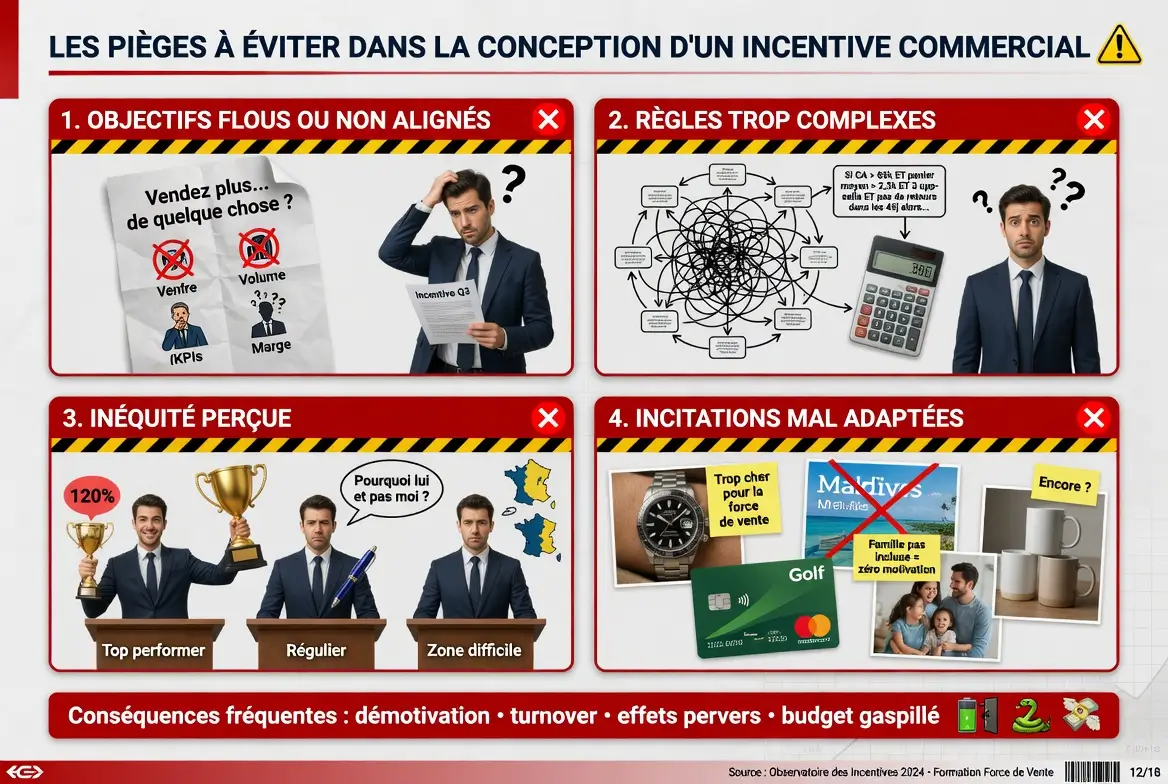
The pitfalls to avoid in the design of a commercial incentive
Three recurring pitfalls undermine program performancecommercial incentive. The first is the over-weighting of variable remuneration at the expense of other levers, which produces the documented performance ceiling. The second is the absence of variation: an identical system from one year to the next is exhausted by hedonic adaptation. The third is the absence of entertainment around rewards: announcing a gift card at the beginning of the year without reminding it generates 4 times less effect than animating the same reward continuously.
In addition, some pitfalls are part of the design of the gamified device. Too severe competition demotivates employees at the bottom of the ranking, unrealistic goals produce the opposite effect to that sought, and an excessive number of simultaneous mechanisms (beyond 6) creates cognitive overload that degrades commitment. The fine calibration of each lever is what distinguishes an effective program from a generic program.
- Overweight of the variable : the commission alone peaks after 18 to 24 months, diversifying is mandatory
- Lack of variation : reproducing the device identically generates fatigue and disengagement
- Gap animation : announcing a reward without calling it back continuously divides its effect by 4
- Toxic competition : unique and severe leaderboard demotivates 70% of the team at the bottom of the ranking
- Cognitive overload : beyond 6 simultaneous mechanics, engagement drops by 20 to 30%
For a robust device, the practical rule is to combine 3 to 5 gamification mechanics (1 main + 2-3 secondary + 0-1 variable), to vary the rewards every quarter and to maintain a weekly animation around the program. This driving discipline is what transforms an incentive program into a driver of sustained performance.
How to measure the ROI of a sales incentive program
Measuring the ROI of a commercial incentive imposed in double measure. First, the direct engagement with the program (participation rate, unlocked badges, frequency of connection to the platform), then the business impact (turnover, margin, average basket, average basket, conversion rate). The practical method consists in comparing these KPIs over 4 weeks before the launch of the program and 4 to 8 weeks after, we have a comparable perimeter.
On the Objow perimeter, the 25,000 users deploy programs that produce on average +83% in engagement, +60% in operational time savings, +18% in business KPIs and +16% in retention over 12 months. These figures are in line with the Aberdeen Group benchmarks on the global market. To scope a project on your specific context, Request a free Objow demo and talk with our team.
Frequently asked questions about the sales incentive
What is the difference between a commercial incentive and a commission?
One commercial incentive is a global system that combines several levers (monetary, non-monetary, gamified), while commission refers only to variable remuneration indexed to sales. Concretely, the commission is one of the monetary levers of an incentive program, but does not summarize it. A modern program integrates commission, bonuses, gift cards, gift cards, gift cards, challenges, badges and rankings into a single coordinated system. This multi-lever approach produces an average of +22% in turnover over 12 months according to Aberdeen Group.
Is the commercial incentive effective for external networks (distributors, franchisees)?
Yes, and it is even particularly decisive in these areas because traditional monetary levers are contractual and less flexible than for internal teams. Gamified (sell-out challenges, progressive badges, regional rankings) and non-monetary (gift cards, training, partner status) are becoming the main levers for animation. The Manpower case documents +16% of active customers after deploying a modern incentive system on the branch network. For business providers, regional rankings and progressive badges boost performance without increasing pay.
How much does a modern business incentive program cost?
A program ofcommercial incentive Modern technology typically represents 3 to 8% of commercial payroll, including variable compensation and non-monetary rewards. The gamified animation platform itself costs between 30 and 80 euros per user per month depending on the functional scope. The documented ROI (+22% in turnover over 12 months according to Aberdeen) largely covers the investment. Concretely, on a team of 50 salespeople generating 25 million euros in annual turnover, the net ROI over 12 months is 4 to 6 times the initial investment.
What platform should you choose to manage a commercial incentive?
The choice of platform depends on the scope (internal teams only vs external networks included), the number of users and the CRM integration required. Major players in the French market include Objow (integrated gamification and external networks), Pluxee (rewards focus), Glady (gift cards), Beqom (integrated gamification and external networks), Beqom (complex variable). For an integrated device that combines management, gamification and external networks with Salesforce, HubSpot, Pipedrive and Monday connectors, Objow is positioned on the French market with more than 25,000 deployed users.
How long should you plan for the deployment of an incentive program?
The deployment of a program ofcommercial incentive Modern takes 6 to 12 weeks depending on the complexity. The first 2 weeks are devoted to scoping (objectives, scope, levers, rewards), the following 4 weeks are devoted to CRM integration and platform configuration, the last 4 to the pilot on a sub-perimeter and then to full deployment. Concretely, the first results appear 4 to 6 weeks after the launch, with an increase in power until the third month. It is this progressiveness that secures adoption.
How to prevent the commercial incentive from running out of steam after a few months?
The exhaustion of a program ofcommercial incentive Comes from Hedonic Adaptation: The Brain Gets Used to Recurring Rewards in 4 to 6 Weeks The parade consists of three rules. First, vary the levers activated (week 1 ranking, week 2 challenge, week 3 booster). Then renew the rewards every quarter (change the type of gift card, alternate training and experiences). Finally, create closed cycles (4 active weeks then 1 week break) to preserve freshness. This management discipline maintains the commitment over 36 months and beyond according to Objow Benchmarks.
The modern commercial incentive is one of the most robust performance levers to activate internal teams and external networks in 2026. To scope a program adapted to your context, Request an Objow demo and discuss with a consultant on the levers to be activated as a priority.



.webp)