Remote Sales Challenge: 10 Ideas to Motivate Your Remote Teams
Voici les deux règles fondamentales à garder en tête lors de la mise en place de votre prochain challenge commercial. Ce retour d'expérience se base sur une enquête réalisée auprès de responsables commerciaux, organisateurs et participants aux challenges.


Sommaire
The remote sales challenge has become, in 2026, a critical operational skill for sales leadership. The widespread adoption of remote work, which now affects 58% of European B2B sales forces according to Owl Labs, has rendered some traditional engagement methods ineffective. Specifically, a challenge announced in a Monday morning team meeting and run in an open-plan office all week no longer works when the team is geographically dispersed and operates asynchronously.
This article proposes 10 sales challenge mechanics specifically designed for hybrid or full remote teams, including their optimal duration, primary motivational driver, and the tools needed for their deployment. The ideas apply equally to internal teams and external networks (remote lead generators, regional partners). To implement these challenges on a platform dedicated to remote engagement, the Objow Challenge solution centralizes the necessary levers.

Why Remote Sales Challenges Require a Different Mechanic
The remote sales challenge differs structurally from an in-person challenge in three dimensions. The first is pace: in person, engagement is synchronous (meetings, team check-ins, open-plan office atmosphere), whereas remotely it must be asynchronous, accessible whenever each salesperson logs in. The second is visibility: without non-verbal cues and the physical atmosphere, progress and rankings must be continuously displayed on a digital dashboard. The third is recognition: without applause in meetings, celebrating victories happens through digital channels (videos, badges, public mentions).
According to a 2025 Gartner survey of 1,800 hybrid sales organizations, 71% report that their engagement strategies designed before 2022 are less effective since the shift to hybrid work. This motivation deficit is reflected in challenge participation rates, which drop from 78% in-person to 46% remotely, without adapting the mechanics. Consequently, redesigning challenges for the remote context is not an option but an operational necessity.
- Asynchronous pace : each salesperson participates at their own pace, the system remains accessible 24/7
- Continuous visibility : real-time dashboard replaces the physical atmosphere of the open-plan office
- Digital recognition : badges, celebration videos, public mentions replacing applause
- Multichannel communication : Slack/Teams, email, mobile push notifications, in addition to the platform
- Enhanced Transparency : 100% visible rules, rankings, and rewards to compensate for the lack of verbal interaction
Consequently, the following 10 ideas are designed to work without synchronous meetings or physical presence. They leverage digital tools to replicate or even enhance the dynamics of in-person challenges.
Idea 1: The Weekly Volume Challenge with Shared Dashboard
The simplest and most robust format: a weekly volume target (qualified calls, meetings held, quotes issued) displayed on a dashboard accessible to the entire team. Sales reps can see their real-time progress, their ranking position, and the finish line. The challenge runs from Monday 9 AM to Friday 6 PM, with automatic rewards for the top 3 and a participation badge for everyone who achieves their individual goal.
This format works particularly well remotely because it requires no meetings, no verbal interaction, and no synchronous coordination. Data comes directly from the CRM, eliminating manual entry. Note that rewards must be delivered digitally (digital gift card, subscription, voucher) to maintain the asynchronous pace.
Idea 2: The Duo Challenge with a Surprise Teammate
Each week, form random duos of two sales reps and set a common goal for them (sum of their sales or activities for the week). The random pairing creates an unexpected social dynamic, and the duo mechanism forces each person to push the other. Essentially, a sales rep who falls behind before the end of the week penalizes their partner, which fosters beneficial collective responsibility.
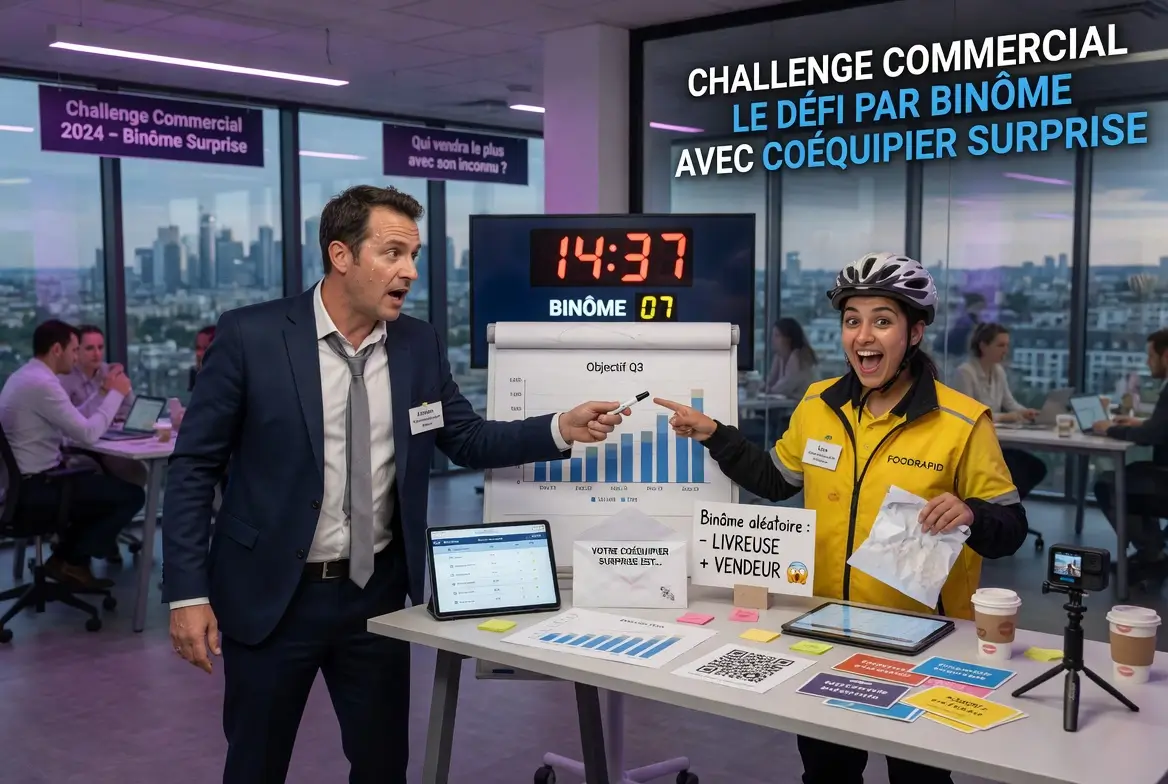
For remote teams, this mechanism replicates the office dynamic (exchanging advice, motivating each other) without requiring a shared office. Duos can communicate via Slack or Teams, and the platform displays the collective score in real-time. This system was implemented at Manpower with a documented effect of +18% participation compared to classic individual challenges.
Idea 3: The Monthly Thematic Sprint
A 4-week sprint focused on a specific theme: upselling, acquiring new logos, reactivating dormant accounts, selling a specific product. The theme focuses the team's attention on a priority business objective for the period, and the 4-week duration is sufficient to produce a measurable impact without eroding due to fatigue.
Remotely, the thematic sprint works better than a general challenge because it gives a clear purpose to the effort. The sales rep knows why they are pushing this week and what is changing. The real-time dashboard displays collective and individual progress, with an intermediate celebration at 50% of the sprint to maintain momentum. This mechanism aligns perfectly with the sales challenge ideas documented on the Objow blog.
Idea 4: The Digital Treasure Hunt
Hide digital "trophies" (special badges, bonus points, access to a premium reward) triggered by specific and unexpected actions: first call at 8 AM, first sale of a new product, longest customer qualification duration. This mechanism introduces positive unpredictability, one of the motivational Core Drives documented by Yu-kai Chou.
Essentially, the sales rep doesn't know exactly which behaviors will be rewarded. The mystery creates greater engagement in secondary actions that the sales rep would usually neglect. Remotely, this mechanism effectively combats routine and fatigue. The platform automatically triggers rewards based on CRM data, without manual manager intervention.
Idea 5: The Daily Activity Marathon
A 5-working-day challenge where the sales rep validates a minimum daily objective each day (e.g., 20 calls, 5 personalized emails, 1 demo). The reward comes from accumulation: validating all 5 days unlocks a bonus, missing a day resets the counter. This mechanism activates the completion bias (wanting to check all 5 boxes) and enforces a regularity that the remote environment makes difficult without a framework.
For hybrid teams, this format provides daily discipline without synchronous meetings. Sales reps validate their deals via the CRM, the dashboard displays everyone's progress, and a reminder is triggered in case of oversight (push notification to catch up). Specifically, teams implementing this challenge observe a 25% increase in daily activity in the week following its launch.
Idea 6: The inter-team tournament
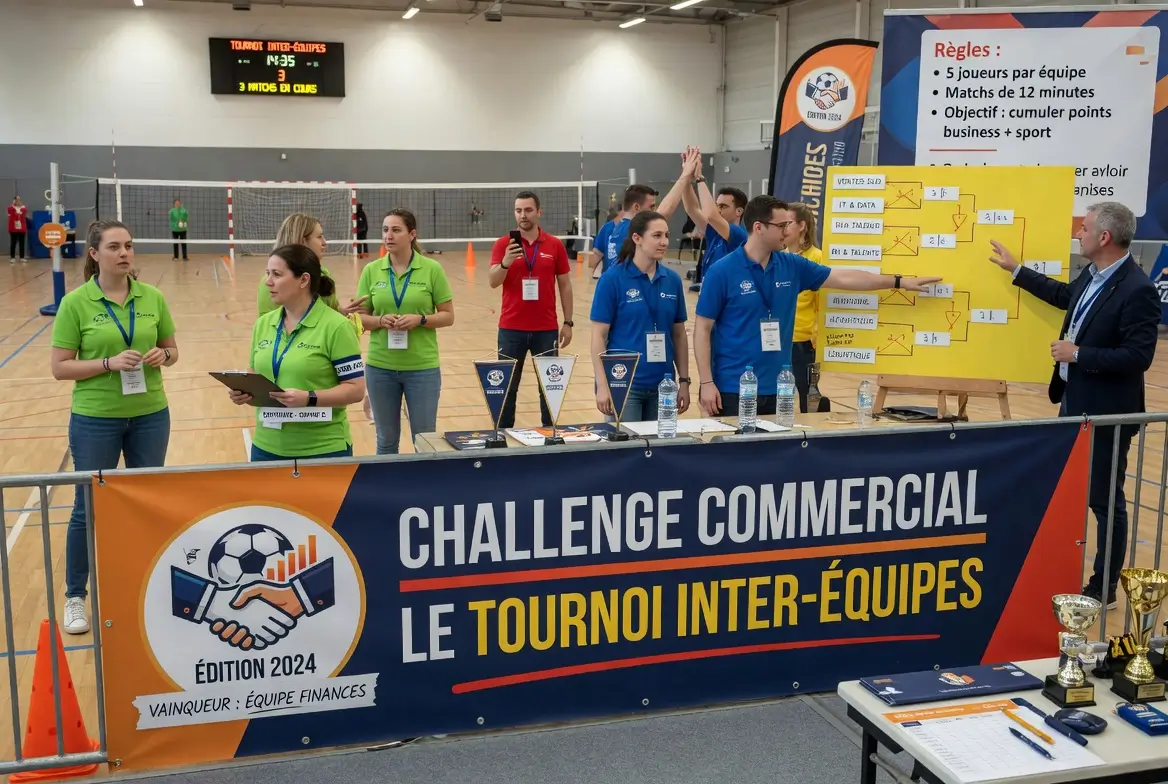
Pit two or three teams (by region, segment, or product) against each other for a common goal over 2 to 4 weeks, with a collective reward for the winning team. The driving force activated is a sense of belonging combined with healthy competition between groups. Specifically, this format engages 70% of the team, compared to the 20% typically involved in a purely individual challenge.
For remote settings, the inter-team tournament requires a collective dashboard visible to everyone, dedicated Slack or Teams channels (one per team) for internal communication, and a video conference closing ceremony to celebrate the winning team. The reward can be individual (bonus per winning team member) or collective (team building budget, team trip). For details on the rules to set, the article on rules for a sales challenge covers best practices.
Idea 7: The creative "share your win" challenge
Ask each sales rep to publicly share, on the platform or on Slack/Teams, a short format (30-second video, post with photo, written testimonial) for each closed sale. Reward the sharing itself, in addition to the sale. This mechanism transforms individual victories into collective moments and compensates for the absence of spontaneous in-person celebrations.
Specifically, each "share your win" generates motivational internal content for the rest of the team. New sales reps discover the techniques of more experienced colleagues, top performers gain visibility, and the sales culture is built organically. For remote teams, this is one of the most powerful tools for replicating team spirit.
Idea 8: The quarterly leveling system
Beyond short-term challenges, a quarterly leveling system (Bronze, Silver, Gold, Platinum) builds a long-term progression path. Each level unlocks cumulative benefits: exclusive training, strategic access, internal status, fixed bonus. Progression is based on points accumulated over the quarter, combining activity, sales, and challenge participation.
For remote teams, the leveling system gives meaning to daily effort by linking it to a visible individual trajectory. Sales reps know where they stand, where they're going, and what effort separates them from the next level. An FMCG B2B brand deployed this system via Objow with its field teams, resulting in a documented +92% DN rate on the targeted reference and an improved retention of 18 months on average. Visible progression effectively compensates for the lack of daily informal feedback from managers.
Idea 9: The customer satisfaction challenge
A remote sales challenge focused on measured customer satisfaction rather than volume. The metric can be post-sale NPS, satisfaction scores from short surveys, or renewal rates. This mechanism avoids the race for volume at the expense of quality, and aligns sales reps with the long-term value of the customer.
Specifically, this format works particularly well in sectors where the sales rep maintains a relationship with the client after the sale (SaaS, recurring services, B2B key accounts). The dashboard displays real-time scores, and badges reward satisfaction levels (NPS above 50, average satisfaction at 4.5/5). For remote teams, this challenge creates a different kind of pride than chasing numbers.
Idea 10: The weekly surprise roulette
Every Friday at 4 PM, launch a virtual roulette that randomly selects a type of reward for the following week (1.5x sales booster, special badge, bonus remote work day, training access). The random nature of the reward keeps the system fresh and combats hedonic adaptation that erodes regular challenges.
This mechanism is particularly well-suited to a remote context because it takes place entirely online, and asynchronous communication (push notification, Slack message, email) is sufficient to trigger it. Specifically, teams that implement a weekly roulette observe sustained engagement for 6 months and beyond, compared to a typical erosion in 2 to 3 months for a challenge without variation.
Summary Table of 10 Remote Sales Challenge Ideas
The table below summarizes the 10 mechanisms for remote sales challenges, including their optimal duration, primary motivational driver, and most suitable application context. This structure allows for quickly defining the setup to be implemented based on the team's profile.
Specifically, a robust remote engagement system combines 3 to 4 of these ideas in parallel, with varied rhythms. This polyrhythm creates continuous engagement dynamics without cognitively overwhelming the team. To delve deeper into the underlying mechanisms, the article on B2B gamification mechanisms details the levers to activate.
How to Run These Challenges on a Dedicated Platform
Running these 10 remote challenge ideas relies on three technical prerequisites. First, a gamified engagement platform connected to the CRM (Salesforce, HubSpot, Pipedrive, monday) to automatically retrieve activity and sales data. Next, a 24/7 accessible dashboard on desktop and mobile, where each salesperson can view their progress and rankings. Finally, a multi-channel communication system (push notification, email, Slack/Teams integration) to re-engage challenges without relying on synchronous meetings.
Specifically, Objow centralizes these three functions into a single platform, with native CRM connectors and a mobile application for field sales representatives. The 25,000 deployed users (CNP Assurances, Manpower, MGEN, Pierre Martinet) cover all contexts: 100% office-based, hybrid, or full remote teams. To determine the deployment best suited to your team's profile, request an Objow demo and discuss with a consultant the mechanisms to prioritize.
Frequently Asked Questions about Remote Sales Challenges
What is the most effective challenge mechanism for a 100% remote team?
For a 100% remote team, the most effective mechanism combines a remote sales challenge weekly challenge focused on volume and a quarterly leveling system for long-term progression. The weekly challenge creates short-term momentum, while the levels give meaning to cumulative effort. Specifically, these two approaches simultaneously activate healthy competition and a sense of progress, the two most robust drivers in a remote context. Teams that combine these two mechanisms show an average participation rate of 78%, compared to 46% for a classic, unadapted setup.
How to maintain engagement in a remote challenge over several months?
Long-term engagement in a remote challenge relies on variation and surprise. Specifically, alternating mechanisms (week 1 volume challenge, week 2 duo challenge, week 3 treasure hunt, week 4 thematic sprint) combats hedonic adaptation, which erodes repetitive setups within 4 to 6 weeks. A surprise weekly roulette complements this strategy by injecting positive unpredictability. It's worth noting that rewards also benefit from variation, rotating between gift cards, training, experiences, and symbolic badges.
Should different challenges be created for hybrid and full remote teams?
Not necessarily. The 10 mechanics detailed in this article work for both hybrid and full remote setups, as they are designed for asynchronous communication and digital visibility. The difference is marginal: full remote teams benefit more from features like "share your win" and inter-team tournaments, which recreate the social dimension missing from daily life. Hybrid teams can supplement this with in-person closing ceremonies on office days. The core of the system remains the same: real-time dashboard, asynchronous mechanics, digital recognition.
What tools are needed to manage a remote sales challenge?
Three tools are necessary: a CRM (Salesforce, HubSpot, Pipedrive, monday) for raw activity and sales data, a gamified engagement platform to orchestrate the mechanics (leaderboards, badges, challenges), and an asynchronous communication channel (Slack, Teams) to re-engage the system. Specifically, Objow combines the engagement platform and CRM integration into a single tool, with native connectors to the market's leading CRMs. The communication layer is added via Slack and Teams integrations, creating a sustainable system for sales reps who don't have to switch tools.
How to prevent a remote challenge from demotivating sales reps at the bottom of the leaderboard?
Demotivation among those at the bottom of the leaderboard is one of the major risks of remote challenges, because public visibility amplifies the feeling of disparity. Three practices limit this risk. First, create several parallel leaderboards (by region, by product, by portfolio size, by relative progress) so that each sales rep can be at the top of at least one. Next, value personal progress ("week-over-week improvement") rather than just absolute performance. Finally, award participation badges accessible to everyone, in addition to competitive rewards.
What is the optimal frequency for a remote sales challenge?
The optimal frequency combines several rhythms in parallel. A weekly challenge for short-term momentum, a monthly sprint for period consistency, a quarterly leveling system for long-term progress, and daily micro-challenges for activity discipline. Specifically, this polyrhythm prevents fatigue and maintains engagement for 36 months and beyond, according to Objow benchmarks. It's worth noting that a single rhythm (e.g., only weekly) erodes within 2 to 3 months, regardless of the initial system's quality.
Remote sales challenges have become a crucial performance lever for hybrid and full remote teams. To transform your existing engagement system or start from scratch, request an Objow demo and discuss with a consultant the mechanics best suited to your team's profile.




.webp)